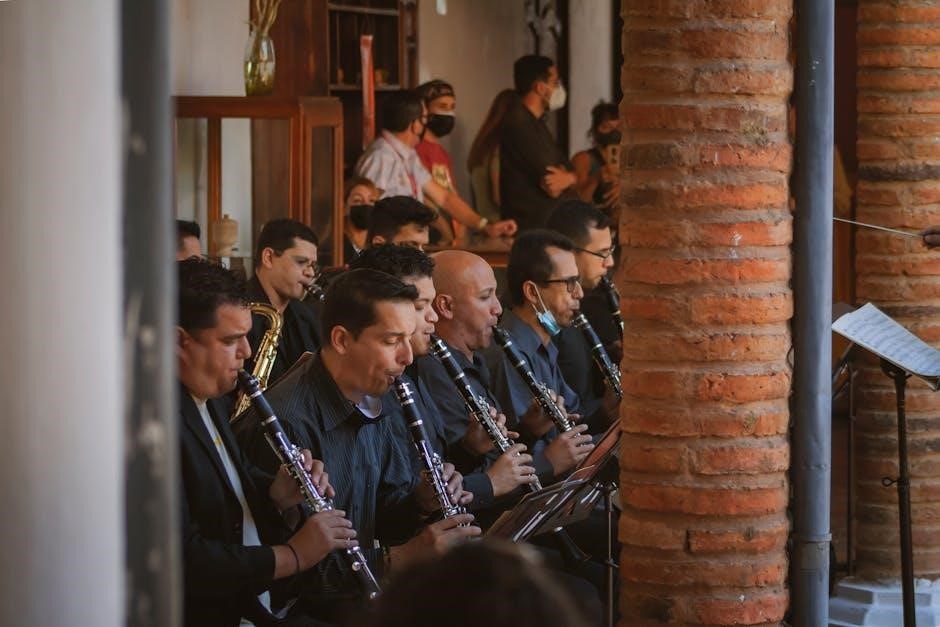
Aaron Copland’s Clarinet Concerto: A Comprehensive Guide
Discover readily available PDF versions of Copland’s concerto through MuseScore.com, offering free access, or explore purchase options like CAMco Music, LLC.
nkoda provides subscription-based access to the full score, alongside other online retailers offering this iconic piece for clarinet enthusiasts and performers.
Historical Context of the Concerto
Commissioned in 1947 by Benny Goodman, the renowned “King of Swing,” Aaron Copland’s Clarinet Concerto emerged during a pivotal period in American music. Post-World War II, a desire for distinctly American musical voices resonated, and Goodman actively championed new works. He specifically requested a concerto from Copland, recognizing his established reputation for blending accessible lyricism with modernist techniques.
This commission arrived after Copland had already achieved significant acclaim with works like Appalachian Spring and Billy the Kid, pieces deeply rooted in American folk idioms. However, the Clarinet Concerto represented a shift towards a more streamlined and concentrated expressive language. Goodman’s clarinet, a B-flat instrument, directly influenced the concerto’s key and technical demands.
The late 1940s also saw a growing interest in chamber orchestral textures, a trend Copland embraced in this work. The concerto wasn’t intended for a massive symphonic ensemble, but rather a more intimate setting, allowing the clarinet’s voice to remain prominent. The premiere, in 1950, solidified the concerto’s place as a cornerstone of the clarinet repertoire.
Copland’s Compositional Style
Aaron Copland, a leading figure in 20th-century American music, developed a distinctive style characterized by its clarity, rhythmic vitality, and incorporation of American folk elements. While drawing inspiration from Stravinsky and other modernists, Copland forged a uniquely accessible sound, avoiding extreme dissonance and prioritizing melodic contours.
In the Clarinet Concerto, this style manifests through open harmonies, often utilizing perfect intervals, and a deliberate avoidance of complex counterpoint. Rhythmic drive is paramount, with frequent use of syncopation and irregular meters. Copland’s orchestration is typically lean and transparent, focusing on highlighting specific instrumental colors.
He masterfully balances lyricism with angularity, creating a compelling dramatic arc. The concerto’s structure—fast-slow-fast—is traditional, but Copland infuses it with his characteristic American sensibility. His use of space and silence is also notable, contributing to the work’s overall sense of spaciousness and contemplation.
Commissioning and Premiere Details
The Clarinet Concerto was commissioned in 1947 by Benny Goodman, the renowned “King of Swing,” who sought a significant addition to the clarinet repertoire. Goodman’s vision was for a work that would showcase the instrument’s lyrical and virtuosic capabilities, moving beyond its traditional role in jazz and popular music.
Copland accepted the commission, and the concerto was completed in 1949. The premiere took place on September 18, 1950, at the Lewisohn Stadium in New York City, with Benny Goodman performing the solo part accompanied by the New York Philharmonic, conducted by Leonard Bernstein.
This initial performance was met with considerable acclaim, establishing the concerto as a cornerstone of the clarinet literature. The work quickly gained popularity, and Goodman continued to champion it throughout his career, performing it extensively both domestically and internationally. The concerto’s success solidified Copland’s reputation as a major orchestral composer.
Availability of Sheet Music (PDF)
Explore numerous PDF options for Copland’s concerto, from free versions on MuseScore.com to purchasable scores via CAMco Music and nkoda subscriptions.
MuseScore.com: Free PDF Versions
MuseScore.com stands out as a fantastic resource for musicians seeking free access to Aaron Copland’s Clarinet Concerto in PDF format. This platform hosts a vibrant community of sheet music creators and enthusiasts, offering a readily available digital library.
Users can easily download and print the concerto’s sheet music directly from the website, catering to various instruments beyond just the clarinet – including piano, guitar, and flute arrangements are available.
The availability extends to arrangements for mixed ensembles, showcasing the concerto’s adaptability. A specific arrangement by ‘codyharding06’ for Piano, Bass guitar, Harp, Strings group, and more instruments was uploaded on May 14, 2024.
MuseScore.com’s extensive catalog, boasting over a million digital music sheets, makes it an invaluable tool for musicians of all levels – from beginners to seasoned professionals – looking to practice, learn, or simply enjoy Copland’s masterpiece.
CAMco Music, LLC: Purchase Options (Piano Reduction)
CAMco Music, LLC offers both a piano reduction and the full score of Aaron Copland’s Clarinet Concerto for purchase. The piano reduction version is available for $25.00, providing a practical option for rehearsal and study purposes.
This arrangement includes parts for B-flat Clarinet and Piano, totaling 12 pages in length. CAMco’s website provides a detailed listing with specifications, allowing musicians to assess the suitability of the edition for their needs.
Alongside the sheet music, CAMco also includes options to “Listen” to excerpts, aiding in familiarization with the piece. The full orchestral score is also available for $40.00, encompassing parts for B-flat Clarinet, Harp, Piano, and String Orchestra.
CAMco Music, LLC serves as a reliable source for acquiring professionally prepared scores of this significant 20th-century work, catering to both individual performers and ensembles.
nkoda: Subscription-Based Access (Full Score)
nkoda presents a compelling access route to Aaron Copland’s Clarinet Concerto through its subscription service. Rather than a direct purchase, users gain access to the full score – published by Boosey & Hawkes – as part of a broader library of over 110,000 scores.
This subscription model allows musicians to explore a vast repertoire without the commitment of individual sheet music purchases. nkoda offers a free 7-day trial, enabling potential subscribers to evaluate the platform and its offerings before committing to a paid plan.
The digital format provides convenient access on the nkoda app, facilitating study and performance preparation. This is particularly beneficial for musicians who frequently perform or study diverse works, as it eliminates the need for physical sheet music storage.
nkoda’s platform delivers a modern and efficient way to access Copland’s concerto, alongside a wealth of other musical resources.
Other Online Sheet Music Retailers
Beyond MuseScore.com, CAMco Music, LLC, and nkoda, several other online retailers offer options for acquiring Aaron Copland’s Clarinet Concerto in PDF format. While specific availability can fluctuate, platforms like Sheet Music Plus and Musicnotes.com are worth investigating.
These retailers often carry a range of arrangements and editions, potentially including piano reduction scores alongside full orchestral versions. Comparing prices and formats across multiple platforms is advisable to secure the most suitable option.
It’s crucial to verify the legitimacy of the source and ensure the PDF is legally obtained to support composers and publishers. Checking user reviews and the retailer’s reputation can provide valuable insights.
Exploring these additional resources expands the possibilities for accessing Copland’s concerto, catering to diverse preferences and budgetary considerations.
Instrumentation and Scoring
Copland’s concerto features a solo B-flat clarinet, accompanied by harp, piano, and a string orchestra; full orchestral scores are also available in PDF.
Solo Clarinet (B-flat)
The cornerstone of Aaron Copland’s Clarinet Concerto is, naturally, the solo clarinet, specifically pitched in B-flat. This choice allows for a comfortable range and tonal quality suited to the concerto’s expressive demands.
Sheet music availability in PDF format consistently highlights the B-flat clarinet part, catering to performers seeking accessible scores. Whether sourced from MuseScore.com’s free offerings or purchased through CAMco Music, LLC, the clarinet score is central.
Performers will find the solo part demanding, requiring both technical proficiency and a nuanced understanding of Copland’s musical language. The PDF scores available often include detailed fingerings and phrasing suggestions, aiding in interpretation.
Accessing the clarinet part via platforms like nkoda provides a high-quality digital edition, ensuring clarity and ease of reading during practice and performance. The B-flat clarinet’s role is not merely melodic; it’s integral to the concerto’s overall texture and emotional impact.

Harp and Piano Roles
Copland’s Clarinet Concerto uniquely integrates both harp and piano into its orchestral texture, creating a distinctive sonic landscape. PDF scores readily available from sources like CAMco Music, LLC clearly delineate the parts for both instruments.
The piano part, often a piano reduction of the full orchestral score, is particularly useful for rehearsal and study. These PDF versions, available for purchase, allow clarinetists to practice with accompaniment.
The harp contributes shimmering textures and harmonic support, enhancing the concerto’s lyrical passages. MuseScore.com offers free PDF arrangements that showcase the interplay between the clarinet, harp, and piano.
While the clarinet takes center stage, the harp and piano are not merely accompanimental; they are integral to the concerto’s harmonic and rhythmic fabric. nkoda provides access to full scores where the interplay is fully visible, aiding in a deeper understanding of Copland’s orchestration.
String Orchestra Arrangement
Copland’s Clarinet Concerto features a lush string orchestra arrangement, providing a rich harmonic foundation for the solo clarinet. Accessing PDF scores, such as those offered by CAMco Music, LLC, reveals the intricate voicing and interplay within the string section.
The strings often provide sustained chords and lyrical countermelodies, complementing the clarinet’s expressive lines. MuseScore.com hosts various PDF arrangements, including versions specifically highlighting the string parts for study and rehearsal.
The arrangement isn’t simply supportive; it actively participates in the concerto’s dramatic arc, building tension and releasing it alongside the clarinet. nkoda’s subscription service grants access to the full score in PDF format, allowing detailed examination of the string writing.
Understanding the string arrangement is crucial for both performers and listeners, as it significantly contributes to the concerto’s overall emotional impact. These readily available PDF resources facilitate a deeper appreciation of Copland’s masterful orchestration.
Full Orchestra Score Availability
Obtaining the full orchestral score in PDF format for Copland’s Clarinet Concerto requires exploring specific resources. CAMco Music, LLC offers the complete score for purchase, providing a professional-quality PDF suitable for conductors and serious study.
This version, priced at $40.00, includes all instrumental parts and is essential for a complete understanding of Copland’s orchestration. nkoda also provides access to the Boosey & Hawkes edition of the full score through its subscription service, delivering a digital PDF.
While free PDF versions of the full score are less common, exploring online sheet music retailers may occasionally yield results. However, ensuring the legality and accuracy of such sources is paramount.
Access to the full orchestral PDF allows for in-depth analysis of Copland’s compositional techniques and provides invaluable insight for performance preparation and scholarly research. It’s a vital resource for anyone deeply engaging with the concerto.
Musical Analysis
Detailed score PDFs reveal Copland’s masterful structure, lyrical melodies, and rhythmic vitality across three movements, showcasing his unique 20th-century compositional style.
First Movement: Structure and Themes
Examining the PDF score of the first movement, marked “Andante con moto,” reveals a sonata form structure, though subtly altered by Copland’s characteristic approach. The movement begins with a broad, lyrical clarinet statement, establishing the primary thematic material – a wistful, almost nostalgic melody; This initial theme, readily visible in the score, is characterized by its stepwise motion and gentle phrasing.
A contrasting second theme, more energetic and rhythmically driven, emerges shortly after, providing a dynamic foil to the opening. The development section skillfully fragments and transforms these themes, exploring their harmonic and melodic possibilities. PDF access allows close study of Copland’s orchestration, particularly his use of string textures and harmonic color. The recapitulation brings back the original themes, though subtly varied, leading to a quiet and reflective coda.
The clarity of the PDF notation highlights Copland’s deliberate use of space and silence, contributing to the movement’s overall expressive quality. Analyzing the score demonstrates how Copland blends traditional forms with his distinctly American voice.
Second Movement: Slow and Lyrical Character
The second movement, “Slow and Lyrical,” presents a stark contrast to the first, offering a deeply expressive and introspective experience. A detailed examination of the PDF score reveals a predominantly sustained melodic line for the clarinet, often accompanied by delicate harmonic support from the strings and harp. This movement eschews traditional formal structures, instead unfolding as a series of evolving musical gestures.
The clarinet’s melody, beautifully notated in the PDF, is characterized by its long, arching phrases and subtle dynamic nuances. Copland masterfully employs harmonic ambiguity, creating a sense of yearning and emotional depth. The harp plays a crucial role, adding shimmering textures and reinforcing the lyrical character of the movement.
Studying the PDF allows observation of Copland’s careful attention to voicing and balance, ensuring that the clarinet’s voice remains prominent while blending seamlessly with the orchestral fabric. It’s a movement of quiet intensity, showcasing the clarinet’s expressive capabilities.
Third Movement: Virtuosity and Rhythmic Drive
The final movement bursts forth with energetic rhythms and demands considerable technical prowess from the clarinetist, as clearly indicated within the PDF score. This section showcases Copland’s signature American sound – a blend of jazz-influenced syncopation and driving momentum. Analyzing the PDF reveals intricate passages requiring agility, precision, and a robust tone.
The movement is characterized by its playful interplay between the clarinet and the orchestra. Copland utilizes a variety of rhythmic devices, including ostinatos and irregular accents, creating a sense of excitement and forward motion. The PDF demonstrates the complex interplay between the clarinet’s virtuosic flourishes and the orchestra’s rhythmic underpinning.
A close study of the PDF reveals Copland’s masterful orchestration, which supports and enhances the clarinet’s brilliance. It’s a thrilling conclusion to the concerto, leaving a lasting impression of energy and vitality, demanding a technically secure and musically compelling performance.

Performance Considerations
Accessing the PDF score is crucial for navigating technical challenges and interpretive nuances; careful study aids preparation for the concerto’s demands and artistic expression.
Technical Challenges for the Clarinetist
The Copland Clarinet Concerto presents significant technical hurdles for performers, demanding exceptional control and musicianship. Obtaining a reliable PDF score is the first step in mastering these challenges. The concerto’s wide range requires seamless transitions between registers, testing the clarinetist’s embouchure and air support.
Rapid technical passages and intricate fingerwork are prevalent, particularly in the third movement, necessitating precise articulation and dexterity. The soloist must also navigate complex rhythms and irregular phrasing, demanding a strong sense of pulse and rhythmic accuracy.
Furthermore, the concerto’s lyrical sections require a beautiful tone and expressive phrasing, showcasing the clarinetist’s ability to shape melodic lines with nuance and sensitivity. A clear PDF allows detailed study of Copland’s markings, aiding in accurate interpretation. Stamina is also crucial, as the concerto is a substantial work requiring sustained focus and energy throughout its duration.
Interpretive Approaches
Approaching the Copland Clarinet Concerto requires balancing its lyrical and virtuosic elements. A detailed PDF score is invaluable for understanding Copland’s intentions. Some interpretations emphasize the work’s American folk influences, highlighting its open harmonies and expansive melodies. Others focus on its modernist aspects, bringing out its rhythmic complexity and angularity.
The soloist’s phrasing and dynamic choices significantly shape the concerto’s character. A restrained approach can reveal the work’s introspective qualities, while a more dramatic interpretation can emphasize its emotional intensity. Careful study of the PDF reveals Copland’s dynamic markings and phrasing suggestions.
Ultimately, a successful interpretation balances technical precision with expressive freedom, conveying the concerto’s unique blend of accessibility and sophistication. Considering the historical context and Copland’s compositional style, as gleaned from score analysis, is crucial for a nuanced and compelling performance.
Notable Recordings and Performers
Benny Goodman’s 1950 recording, conducted by Copland himself, remains a landmark interpretation, offering invaluable insight accessible through studying the PDF score alongside the performance. Richard Stoltzman’s recordings showcase a lyrical and expressive approach, while David Shifrin’s interpretations are known for their technical brilliance.
More recent recordings by Anthony McGill and Alexander Fiterstein demonstrate contemporary perspectives on the work. Accessing a high-quality PDF allows performers to compare their interpretations with these established artists, analyzing phrasing, dynamics, and articulation.
These performers consistently demonstrate a deep understanding of Copland’s musical language, bringing clarity and emotional depth to the concerto. Studying their discographies, alongside detailed score analysis from a PDF version, provides aspiring clarinetists with valuable models for their own performances.
The Concerto’s Place in the Repertoire
Copland’s concerto significantly expanded the 20th-century clarinet repertoire, influencing composers and captivating audiences; PDF scores facilitate continued study and performance.
Its enduring legacy ensures its place as a cornerstone of the clarinet world.
Significance in 20th-Century Clarinet Music
Aaron Copland’s Clarinet Concerto stands as a pivotal work, dramatically enriching the 20th-century repertoire for the instrument. Prior to its 1949 premiere, the clarinet lacked a substantial body of significant concerto literature from this period, often overshadowed by works for other instruments. Copland’s contribution was therefore groundbreaking, establishing a new standard for both artistic merit and technical demand.
The concerto’s success spurred other composers to explore the clarinet’s expressive capabilities in a concerto setting, broadening the instrument’s possibilities. The accessibility of PDF scores, through platforms like MuseScore.com and subscription services such as nkoda, has been instrumental in disseminating Copland’s work and inspiring further performance and study.
Furthermore, the availability of both full and piano reduction scores (from sources like CAMco Music, LLC) allows for wider accessibility, enabling performances in diverse settings and fostering a deeper understanding of Copland’s compositional techniques. This accessibility solidifies its enduring influence on clarinet performance and composition.
Influence on Subsequent Composers
Copland’s Clarinet Concerto demonstrably impacted composers who followed, particularly in their approach to writing for wind instruments. Its blend of American vernacular musical language with sophisticated harmonic structures offered a new model for concerto form. The concerto’s success encouraged exploration of distinctly American musical idioms within classical frameworks.
The widespread availability of the score, now easily accessible in PDF format via platforms like MuseScore.com and through purchases from CAMco Music, LLC, facilitated study and analysis by aspiring composers; This accessibility allowed them to deconstruct Copland’s techniques – his use of space, rhythmic vitality, and melodic contours.
Moreover, the concerto’s influence extends beyond direct stylistic imitation. Composers were inspired by Copland’s ability to create a work that was both technically challenging for the performer and emotionally resonant for the audience, a balance that continues to inspire contemporary musical creation. nkoda’s subscription access further amplifies this influence.
Critical Reception and Legacy
Upon its premiere, Copland’s Clarinet Concerto garnered largely positive reviews, praised for its lyrical beauty, rhythmic energy, and skillful orchestration. Critics noted its accessibility while acknowledging its sophisticated compositional techniques. The concerto quickly established itself as a cornerstone of the clarinet repertoire, a position it maintains today.
The increasing availability of the score in PDF format, through resources like MuseScore.com and commercial vendors such as CAMco Music, LLC, has broadened its reach, fostering continued performance and study. This accessibility ensures the work’s enduring presence in conservatories and concert halls worldwide.
Its legacy lies not only in its musical qualities but also in its role as a significant contribution to 20th-century American music. nkoda’s digital access further solidifies this legacy, allowing new generations of musicians to engage with Copland’s masterpiece and appreciate its lasting impact.